


Any honest Philippine Economic Review of 2026 has to start with a hard number. Growth in the second quarter fell to 2.3 percent, the weakest reading since 2009 outside the pandemic years.
Three facts define the year so far:
- Growth halved. First-half GDP growth in the Philippine economy averaged 2.6 percent, against 5.4 percent in the same period of 2025.
- Inflation peaked then eased. It hit 7.2 percent in April and slowed for four straight months to 6.1 percent in August.
- Costs stayed up. The policy rate sits at 5.00 percent after three consecutive hikes.
This Philippine Economic Review finds 2026 was a slow-growth, high-cost year: 2.6 percent first half growth, 6.1 percent August inflation, and a 5.00 percent policy rate. For 2027, the government targets project 5.0 to 6.0 percent growth, but inflation forecasts range widely from 3.2 to 5.4 percent. SMEs should plan for better revenue and persistent costs.
The Philippine Economic Review 2026 at a Glance
| Indicator | 2025 | 2026 latest | Direction |
| GDP growth | 4.4% full year | 2.6% first half | Sharply down |
| Inflation | 1.7% full year | 6.1% in August | Sharply up |
| Policy rate | Easing cycle | 5.00% after 3 hikes | Reversed |
| Unemployment | n/a | 6.0% in July | Four-year high |
| Government target | 5.5% to 6.5% | Cut to 3.5% to 4.5% | Downgraded |
The unemployment figure deserves particular attention in any Philippine Economic Review. July’s 6.0 percent rate, equal to 3.14 million Filipinos, was the highest since June 2022, up from 4.9 percent in June.
What Went Wrong: The Philippine Economic Review of Three Shocks
| Shock | What happened | Effect |
| Energy | Strait of Hormuz closed in March after the Middle East conflict | Oil prices surged, inflation ran from 2.4% in February to 7.2% in April |
| Governance | Flood control corruption investigations from late 2025 | Public construction stalled, cited by the IMF and OECD as a drag |
| Investment | Confidence collapsed alongside the above | Gross capital formation fell 9.2 percent in Q2 |
The quarterly picture
| Quarter | GDP growth |
| Q1 2026 | 2.8% |
| Q2 2026 | 2.3% |
| First half average | 2.6% |
Inside that Q2 number, the Philippine economy split in two: services grew 4.5 percent and agriculture 2.7 percent, while industry contracted 2.4 percent. Household consumption rose only 2.8 percent.
Structure decisions carry more weight when the Philippine economy splits like this, so company registration in the Philippines is best treated as a financial decision rather than paperwork.
Inflation Through 2026, Month by Month
| Month | Headline inflation |
| February | 2.4% |
| March | 4.1% |
| April | 7.2% (three-year high) |
| May | 6.8% |
| June | 6.4% |
| July | 6.2% |
| August | 6.1% |
Year-to-date average through August: 5.2 percent, well above the 2 to 4 percent target band. Core inflation eased to 4.1 percent. This is the single series any Philippine Economic Review should track monthly.
Two categories are still running hot and matter more than the headline for most SMEs:
- Rice: 19.4 percent in August, the fastest in more than two years
- Transport: 13.5 percent, up from 11.9 percent in July
The Wage Order Situation Is Still Unresolved
This is the item most 2027 payroll plans get wrong. No Philippine Economic Review is complete without it.
| Date | Development |
| 23 Jun 2026 | RTWPB-NCR issues Wage Order NCR-27: P85 in two tranches |
| 25 Jul 2026 | First P60 tranche was due to take effect |
| 30 Jul 2026 | Pasig RTC issues a temporary restraining order |
| 13 Aug 2026 | Writ of preliminary injunction granted, P10 billion bond |
| 26 Aug 2026 | Supreme Court En Banc orders respondents to comment |
| 8 Sep 2026 | Wage board approves Wage Order NCR-28, a separate P60 increase, 4-3 vote |
Where this stands today:
- NCR-27 remains frozen. Its P25 second tranche, scheduled for 20 January 2027, is not guaranteed.
- NCR-28 delivers the P60 in a single tranche and is with the NWPC for review.
- If affirmed and published, NCR-28 could take effect around 26 or 27 September 2026, bringing the non-agricultural minimum to P755.
- Labour officials indicate the combined 2026 increase would reach P120 if the injunction is lifted.
What to do: pay what the confirmed order requires, accrue for P780, and follow DOLE and NWPC advisories rather than news summaries.
Planning headcount alongside pay bands, often with HR and recruitment support, absorbs either outcome without an emergency correction.
What 2027 Looks Like: The Forward Half of This Philippine Economic Review
| Source | Publication | 2027 GDP growth | 2027 inflation |
| Government (DBCC) | June 2026 | 5.0% to 6.0% | 4.0% to 5.0% |
| Asian Development Bank | ADO July 2026 | 5.3% | 3.9% |
| OECD | June 2026 | 5.0% | Not specified |
| IMF | WEO July 2026 | Within 5% to 6% | 3.2% (April round) |
| Bangko Sentral ng Pilipinas | September 2026 | Not published | 5.4% |
The growth forecasts agree, which is rare. That is the genuinely good news in this Philippine Economic Review.
One caution the IMF stated plainly: the 2027 rebound is driven mainly by favourable base effects alongside a gradual pickup in investment. A recovery that looks strong partly because 2026 was weak is still a recovery, but it is not the same as surging demand.

Why the 2027 Inflation Forecasts Disagree
This spread is the single biggest planning risk in the whole Philippine Economic Review.
| Forecaster | Date | 2027 inflation |
| Pantheon Macroeconomics | Sep 2026 | 3.2% |
| Asian Development Bank | Jul 2026 | 3.9% |
| Government (DBCC) | Jun 2026 | 4.0% to 5.0% |
| Maybank Investment Bank | Sep 2026 | 5.1% |
| Bangko Sentral ng Pilipinas | Sep 2026 | 5.4% |
That is a 2.2 point gap between the most optimistic forecaster and the central bank itself. The BSP’s own projection has inflation breaching its 3 percent target for a third consecutive year, easing only to 3.3 percent in 2028.
The practical rule: budget against the pessimistic end. Being wrong in that direction costs far less than the reverse.
What the 2027 Budget Signals
| Item | 2026 | 2027 proposed |
| National budget | P6.793 trillion | P7.2 trillion (21.7% of GDP) |
| Revenue target | P4.81 trillion | P5.205 trillion |
| Disbursements | n/a | P6.90 trillion |
| Fiscal deficit | 5.4% of GDP | P1.69 trillion |
| Peso assumption | P60 to P62 | P60 to P62 |
Fiscal policy is a reliable guide, and it belongs in every Philippine Economic Review. Revenue is set to rise about 8 percent while growth is projected at 5 to 6 percent. The DBCC attributes the gap to tax digitalisation and stricter compliance, not new taxes.
Translated: collection effort intensifies in 2027, which makes filing discipline a margin issue. Firms that keep accounting and tax compliance current avoid becoming part of the enforcement statistics.
Cost Planning for 2027
| Pressure | 2027 expectation | Preparation |
| Wages | P755 near term, P780 contingent on litigation | Accrue for the higher figure |
| Borrowing | 5.00% now, cuts not expected before mid-2027 | Do not assume cheaper credit |
| Inflation | Forecasts from 3.2% to 5.4% | Budget the pessimistic case |
| Currency | Official assumption P60 to P62 | Review revenue currency mix |
| Tax enforcement | Revenue target up about 8% | Tighten documentation now |
| Demand | Growth 5.0% to 6.0% | Prepare capacity, not discounts |
The asymmetry is the point of this Philippine Economic Review: revenue conditions improve in 2027, cost conditions only improve if the optimistic forecasts prove right.
Your Q4 2026 Checklist From This Philippine Economic Review
| Priority | Action | Why |
| 1 | Build two 2027 budgets, at 3.9% and 5.4% inflation | Identifies which decisions actually change |
| 2 | Accrue for the full P780 wage floor | A favourable ruling should not be a cash shock |
| 3 | Prepare capacity rather than discounts | Growth rewards firms that can serve demand |
| 4 | Audit documentation before enforcement tightens | Reconstructing records after a notice costs more |
| 5 | Cut overhead that does not scale with revenue | Office footprint is the largest reversible cost |
On that last point, a compliant business address and virtual office setup preserves registration requirements at a fraction of a lease.
Sequencing these against cash position is where owners stall, and structured advisory services help before capital is committed to a partly arithmetic recovery.
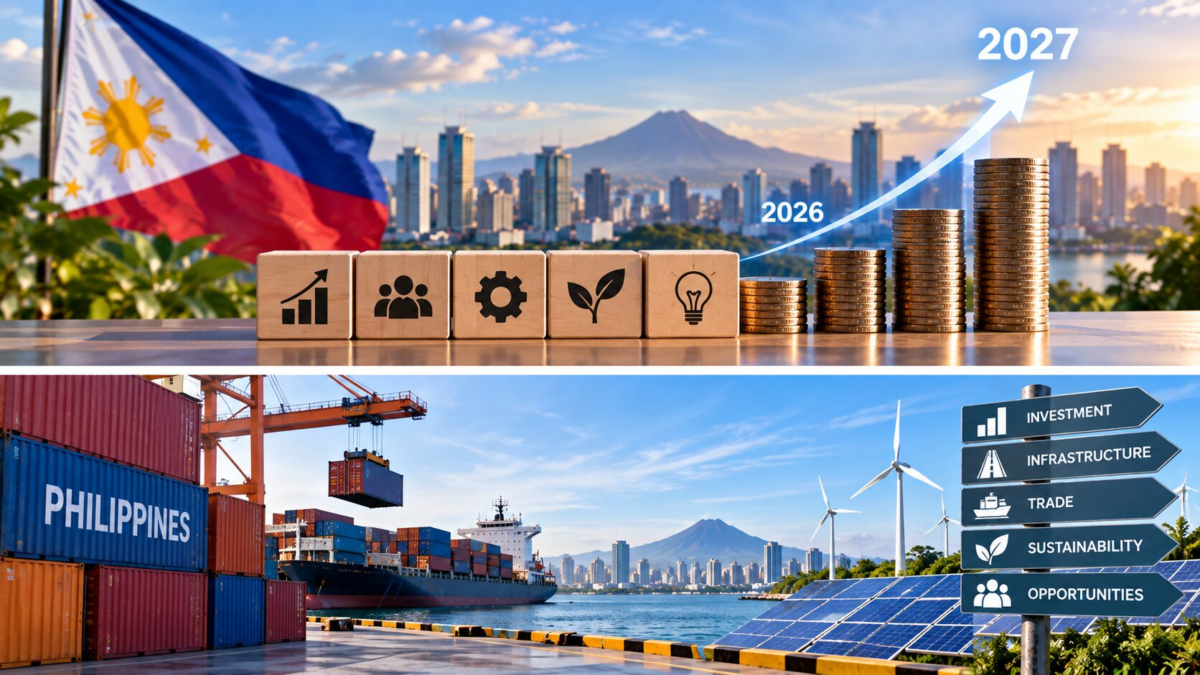
Which Sectors This Philippine Economic Review Favours for 2027
| Sector | 2027 position | Why |
| IT and business process management | Strong | Dollar earnings hold value against a P60 to P62 peso |
| Construction and infrastructure | Improving | Budget prioritises completing flagship projects |
| Consumer retail | Recovering | Only if inflation actually falls |
| Logistics and transport | Cost pressured | Transport inflation at 13.5 percent |
| Food and agriculture | Mixed | Rice inflation at 19.4 percent cuts both ways |
Manufacturers weighing capacity will find more detail in this review of trends in Philippine manufacturing.
Firms scaling online should check the regulatory calendar in our analysis of digital business trends, since several obligations carry into next year.
Adding foreign technical or executive staff makes Philippine visa processing a timing risk rather than an afterthought.
Protecting a brand before competition returns makes early trademark registration among the cheapest insurance available.
Limitations and Considerations
Four caveats apply to this Philippine Economic Review:
- Forecasts keep moving. The BSP Monetary Board still meets on 22 October and 17 December 2026, and at least one bank expects a further hike to 5.25 percent in October.
- Publication dates matter. Some widely quoted 2027 projections predate the February 2026 war shock, including the World Bank’s December 2025 figure.
- Oil dominates. Any durable easing in the Middle East would improve inflation and currency conditions quickly.
- Base effects flatter 2027. A strong headline growth number does not by itself indicate strong underlying demand.
Frequently Asked Questions
How did the Philippine economy perform in 2026?
This Philippine Economic Review finds growth averaged 2.6 percent in the first half, down from 5.4 percent a year earlier, with the second quarter at 2.3 percent, the weakest since 2009 outside the pandemic. Inflation peaked at 7.2 percent in April before easing to 6.1 percent in August, and unemployment reached a four-year high of 6.0 percent in July.
What is the Philippine growth forecast for 2027?
The government targets project 5.0 to 6.0 percent GDP growth in 2027, and every major Philippine Economic Review agrees on the direction. The Asian Development Bank forecasts 5.3 percent and the OECD 5.0 percent. The IMF places its figure within the government range but attributes much of the rebound to favourable base effects after a weak 2026.
Will inflation fall in the Philippines in 2027?
It should fall, but any Philippine Economic Review must report that forecasters disagree sharply. The Bangko Sentral ng Pilipinas projects 5.4 percent, which would breach its 3 percent target for a third straight year, while the Asian Development Bank expects 3.9 percent and Pantheon Macroeconomics 3.2 percent.
Will interest rates go down in 2027?
Not immediately. The policy rate stands at 5.00 percent after three consecutive increases, and one major bank expects a further rise to 5.25 percent in October 2026 before cuts begin around June 2027. Cheaper credit should not be built into first-half 2027 plans.
Is the January 2027 minimum wage increase happening?
It is uncertain. The P25 second tranche sits within Wage Order NCR-27, which a Pasig court enjoined on 13 August 2026. A separate order, NCR-28, granting P60 was approved on 8 September 2026 and is under NWPC review. Employers should accrue for the higher figure and follow official DOLE and NWPC advisories.
Is 2027 a good year to expand a business in the Philippines?
Conditions favour revenue more than costs. For anyone running a business in the Philippines, growth of 5 to 6 percent supports expansion, while elevated inflation, a 5.00 percent policy rate and rising tax enforcement keep the cost side tight. Expanding capacity is safer than expanding fixed overhead when running a business in the Philippines next year.
Key Takeaways
- This Philippine Economic Review shows 2026 delivered 2.6 percent first-half growth, roughly half the prior year’s pace.
- Inflation has eased for four straight months but the year-to-date average of 5.2 percent remains above target.
- Unemployment at 6.0 percent in July was the highest in four years, a signal the slowdown reached households.
- The January 2027 wage tranche is not guaranteed, because it sits inside an order still under court injunction.
- A 2027 revenue target rising about 8 percent against 5 to 6 percent growth points to tighter enforcement, not new taxes.
- Growth forecasts for 2027 agree while inflation forecasts range from 3.2 to 5.4 percent, so the Philippine Economic Review argues for budgeting the pessimistic case.
Conclusion
This Philippine Economic Review closes on a simple contrast. 2026 was a year of absorbing shocks. 2027 looks like a year of selective investment, provided the cost side cooperates.
The asymmetry is what matters. Revenue conditions improve on almost every forecast, while cost conditions improve only if the optimistic inflation projections prove right rather than the central bank’s own.
Firms that prepare capacity, accrue for contingent wage liabilities and tighten documentation will convert a base-effect recovery into real margin. The question worth revisiting each quarter is which inflation forecast is tracking closest to reality.
Plan Your 2027 Position With Local Experts
This Philippine Economic Review gives owners one quarter to position. Entering the market, restructuring costs, preparing payroll for a wage decision that has not landed: the choices you make now shape your business in the Philippines next year.
Contact Philippine Hub Partners for a consultation on registration, tax, HR and compliance strategy built around your position.