


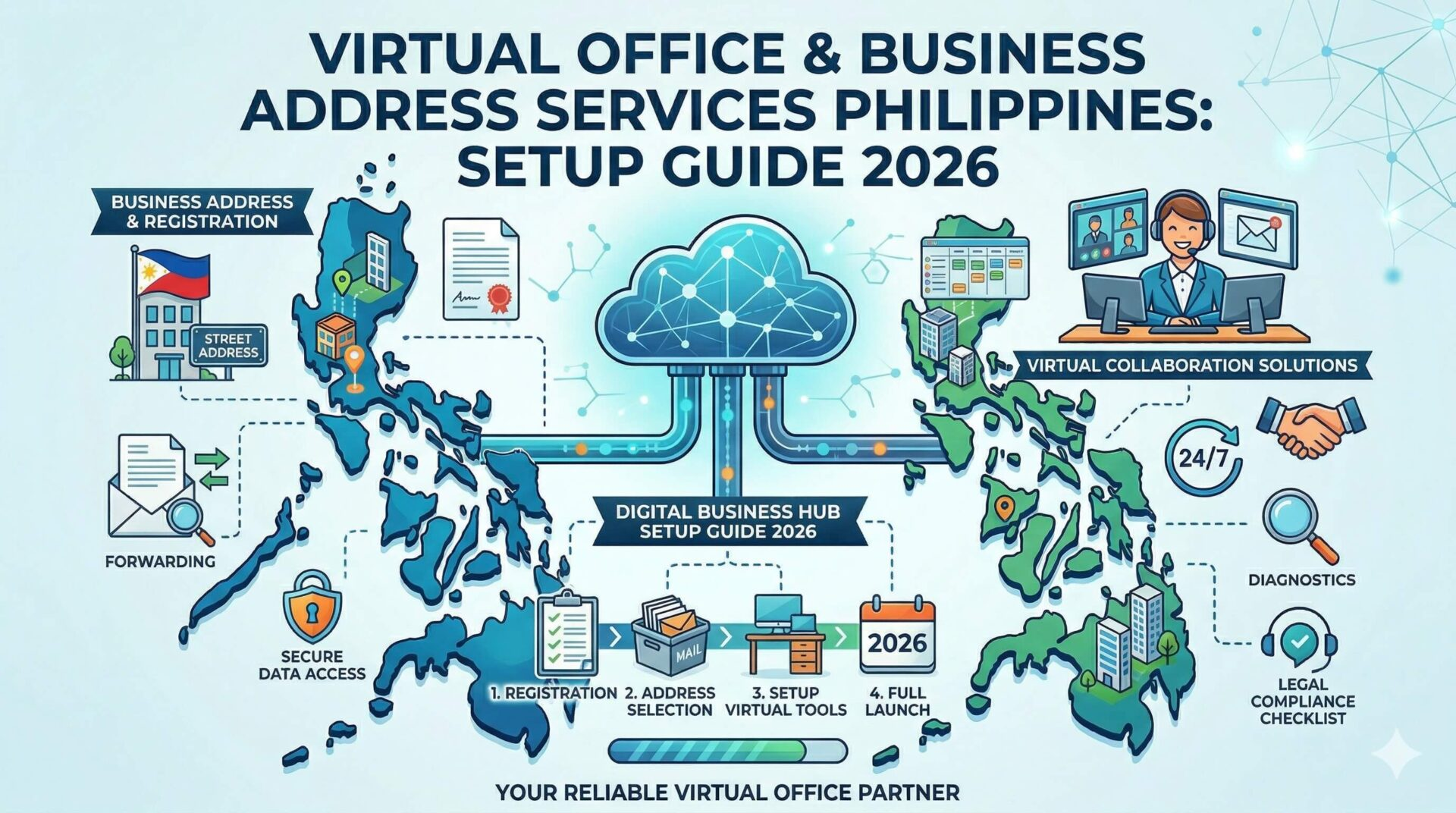
Starting with a virtual office Philippines setup can be a practical way to establish a compliant local presence without committing to a full lease. For startups, foreign-owned entities, consultants, and remote-first teams, a virtual office Philippines package can combine a professional business address, mail handling, and selected office support services at a lower cost than a traditional office.
A virtual office is often suitable when your business needs a legitimate address for registration, tax correspondence, and client-facing credibility, but does not need dedicated daily workspace. The key is choosing a provider whose address, lease documentation, zoning, and support services can stand up to SEC, BIR, and local permit requirements.
This guide explains how business address providers fit into the 2026 registration process, what documents matter, where founders make mistakes, and how to decide whether a virtual office, serviced office, or physical lease is the better compliance choice.
We offer virtual office and business address services across key Philippine business hubs, including Taguig, Makati, Quezon City, and Manila, along with major regions such as Cavite, Laguna, Rizal, Bulacan, Nueva Ecija, Zambales, Oriental Mindoro, Parañaque, Caloocan, and Pasig. This broad coverage helps businesses secure compliant addresses, build credibility, and operate efficiently without the need for a physical office.
Why a virtual office Philippines setup is gaining traction
A virtual office Philippines arrangement gives a business a registered address and administrative support without the overhead of a full office lease. It appeals to founders controlling costs, foreign businesses testing market entry, professional firms operating mainly online, and established companies adding a branch presence.
The value proposition is straightforward. A traditional lease often requires larger deposits, longer terms, fit-out costs, and ongoing facility management. By contrast, flexible address packages separate the legal address function from daily occupancy, which lets organizations preserve capital for hiring, sales, compliance, and market development.
There is also a credibility factor. A central business district address in Makati, BGC, Ortigas, or Cebu can strengthen first impressions with banks, partners, and customers. That does not replace substantive compliance, but it can improve perceived legitimacy when paired with proper registration records and responsive mail handling.
What a virtual business address actually includes
A virtual business address Philippines package is not a single standardized product. Most plans include the core address right, incoming mail receipt, and limited mail notification or forwarding. Higher-tier plans may add receptionist support, local phone answering, meeting room credits, coworking access, document scanning, and occasional desk use.
Some providers also bundle incorporation or broader corporate services support. That can be useful when you want one team coordinating registration, tax setup, payroll, and annual compliance. What matters is whether the provider can issue documents that support registration and whether the address is appropriate for your business activity.
A low monthly fee is not automatically a better deal if the provider cannot give clear service documentation, cannot explain local permit expectations, or does not have a process for handling official notices promptly.
When business address services Philippines make sense
A virtual office Philippines model usually works best when your operating model is remote, hybrid, consultative, or market-entry focused. It is often a strong fit for advisory firms, back-office teams, technology companies, representative functions, and businesses that meet clients by appointment rather than through daily walk-in traffic.
It is less suitable for operations that depend on heavy inventory, daily foot traffic, warehousing, clinical services, food handling, or other regulated activities tied to a physical site. In those cases, the address is not just an administrative anchor. It is part of operational licensing, inspections, and site-specific compliance.
This raises a critical question: are you buying an address, or are you buying a compliant operating base? If the answer is only the former, a virtual business address Philippines package may be enough. If the answer includes frequent onsite work, storage, regulated equipment, or public-facing operations, you should evaluate a serviced office or conventional lease instead.
The 2026 setup path: how the address fits into registration
The registration sequence still matters. For planning, the address issue should be solved early because it influences downstream steps from entity registration to tax registration and local permits.
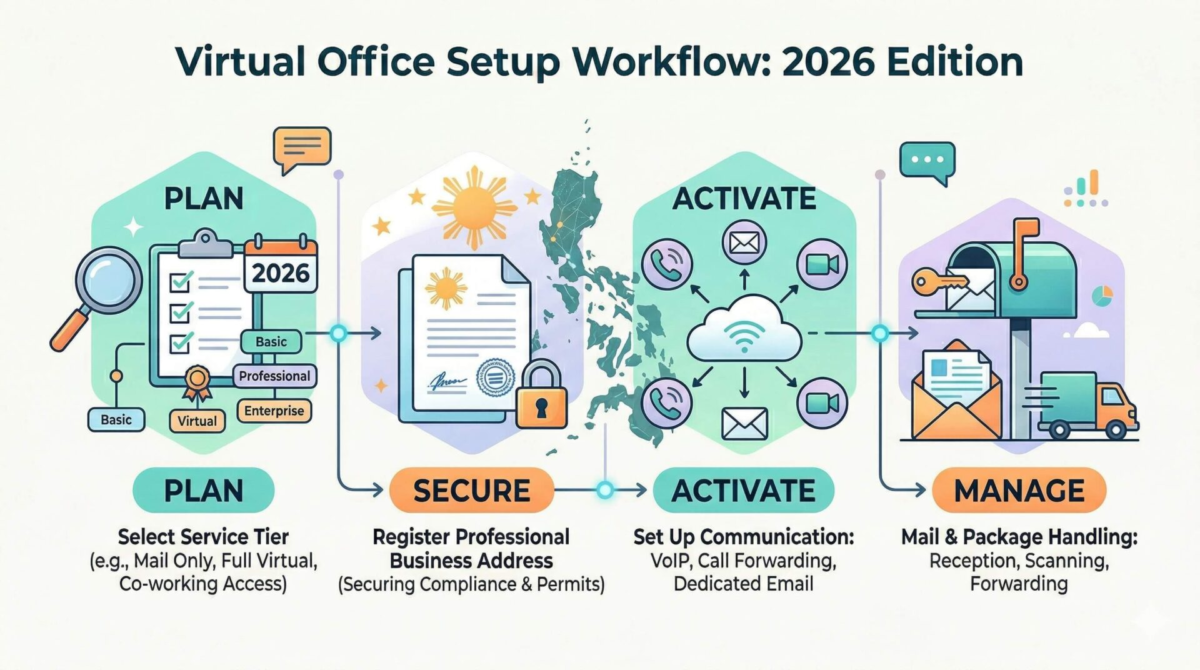
A workable setup sequence looks like this:
- Choose the structure and confirm whether your activity can realistically operate from a virtual office.
- Select a provider and collect the service agreement, address details, and supporting building documents.
- Complete name and entity registration through the appropriate portal.
- Use the chosen address consistently for tax registration, permit applications, and official correspondence.
- Confirm the correct Revenue District Office and local government unit requirements before filing.
- Establish a mail handling process so official notices do not sit unattended.
SEC, BIR, and LGU considerations you should not ignore
A virtual office Philippines setup can support registration, but each layer of compliance has its own lens.
At the SEC level, the company application process requires current and valid business contact information, and the principal office address should reflect where the company is located within the Philippines. Digital registration has become more streamlined, but accuracy still matters.
At the BIR level, the address affects which Revenue District Office has jurisdiction and where taxpayer registration is anchored. Later address changes also require documentary support tied to the new registered business address.
At the LGU level, practical friction tends to be highest. Local permit processing may involve lease-related documents, barangay clearance, locational clearance, and occupancy-related requirements. That means your provider’s paperwork and the building’s zoning reality matter more than the marketing page.
How to choose a compliant provider in 2026
The best providers do more than rent mailbox access. They can explain what their address has been used for, what documents they issue, how mail is logged, what response times apply, and whether clients can access meeting space when banks, regulators, or partners request an in-person touchpoint.
Use five filters when comparing vendors:
- document readiness for registration and permits
- building suitability for the intended business activity
- reliable mail handling and escalation for government notices
- service scope, including whether broader corporate services are available
- upgrade paths into meeting rooms, coworking, or serviced offices
A useful benchmark is whether the provider can answer compliance questions in plain language. If every answer comes back as marketing copy, the risk is higher than the savings justify.
Common mistakes that delay setup
The most common mistake is choosing on price alone. A cheaper address can become expensive if it causes permit delays, missed notices, or refiling work.
The second mistake is using inconsistent address information across registrations, invoices, tax records, and bank documents. Small mismatches create unnecessary clarification requests.
The third mistake is assuming a virtual office works for every business model. Some founders buy a virtual office Philippines plan before confirming whether their activity requires a more operational site.
The fourth mistake is treating mail handling as a minor detail. A credible provider should have a documented process for receipt, notice, forwarding, and escalation.
The fifth mistake is failing to plan for growth. A company that starts with a virtual business address Philippines package may later need staff seating, board meeting space, or branch registration support.
Cost expectations and value trade-offs
Pricing varies by city, address quality, and service depth. Public provider pages show that the market spans low-cost entry plans and premium operators with broader bundled support. What you are really buying is not only an address. You are buying reliability, responsiveness, and lower administrative friction.
A sensible evaluation framework compares three costs: monthly provider fees, expected compliance support costs, and the opportunity cost of delays. A cheaper package may still be the wrong choice if it does not support business registration cleanly or if your team has to spend substantial time resolving avoidable address questions.
This makes provider selection a strategic compliance decision, not a routine procurement task.
A practical decision framework
If you need a fast, cost-controlled local presence, a virtual office Philippines package is often the right starting point. If you need occasional client meetings, add meeting room access. If you need regular staff occupancy, consider a serviced office. If you need site-specific operations, inspections, or inventory handling, secure a physical lease.
A good decision framework asks four questions. Is the address acceptable for the entity and activity you are registering? Can the provider support documentation and official correspondence reliably? Will the package still work six to twelve months from now? And does the provider reduce compliance burden rather than simply selling a prestigious postcode?
Key Takeaways
- A virtual office Philippines setup is most effective when your business needs a compliant address and administrative support, but not a full-time physical office.
- The right provider should be evaluated on document readiness, mail handling, building suitability, and upgrade options, not price alone.
- Your registered address affects SEC filings, BIR jurisdiction, and local permit workflows, so it should be decided early in the setup process.
- A virtual business address Philippines package can improve flexibility and credibility, but it is not a substitute for confirming whether your actual business activity fits the address model.
- Bundled corporate services can add value when you need coordinated help with registration, tax, payroll, and ongoing compliance.
Conclusion
A strong virtual office Philippines strategy is less about renting a prestigious address and more about creating a registration-ready foundation for the next stage of your business. When the provider, documentation, and operating model align, a virtual office can reduce cost, improve flexibility, and support a cleaner launch path.
Founders that treat the address, tax setup, local permits, and mail handling as one coordinated decision usually move faster and with fewer avoidable corrections.
FAQs
Can I use a virtual office for business registration in the Philippines?
Yes, many businesses use a virtual office Philippines setup for registration, but suitability depends on the business activity, the provider’s documents, and local permit expectations. The safest approach is to verify the address package against SEC, BIR, and LGU requirements before filing.
Is a virtual business address the same as a registered office?
Not always. A virtual business address Philippines package may serve as the registered address, but the legal and operational acceptability depends on the entity, the documents issued by the provider, and the nature of the business.
What documents should a provider be able to give me?
At a minimum, ask about the service agreement, address details, mail handling terms, and any supporting documents commonly used for registration or permit processing. Documentation quality is often more important than a low headline price.
How much does a virtual office cost in the Philippines?
Costs vary widely by city and service level. Entry plans may focus on address and mail handling, while premium plans include meeting rooms, phone answering, and workspace access.
Do foreign-owned companies benefit from corporate services support?
In many cases, yes. Foreign-owned or market-entry businesses often benefit when corporate services support is bundled with the address package because registration, tax setup, payroll, and ongoing compliance can be coordinated through one provider.