

What leaders need to know in 2026
HR Recruitment Philippines has entered a new phase in 2026, and HR leaders are adjusting their HR Recruitment Philippines playbooks accordingly. The country remains one of Asia’s deepest English-speaking talent pools, but hiring is now shaped by tighter competition for in-demand skills, higher expectations on flexibility, and faster cycles driven by digital-first candidate behavior. At the same time, more organizations are blending in-house hiring with outsourced recruiting, RPO, and employer-of-record models to scale teams without adding compliance risk.
In 2026, the strongest HR Recruitment Philippines strategies combine (1) role-based sourcing tactics, (2) compensation and flexibility aligned to market reality, and (3) the right operating model, whether direct hiring, recruitment process outsourcing (RPO), or an Employer of Record (EOR) for entity-free employment. The goal is not “more applicants,” but better-fit hires with predictable time-to-fill.
This guide maps the hiring trends most relevant to decision-makers and then turns them into an execution plan you can use with your team or partners like Philippine Hub Partners. It is written for leaders who need HR Recruitment Philippines outcomes they can forecast.
Hiring market signals for 2026
A practical way to read 2026 is to separate “macro” from “day-to-day.” Macro conditions set the ceiling, but your outcomes depend on the mechanics of how candidates search, compare, and decide.
First, the Philippines continues to be a global outsourcing and shared services hiring Philippines hub, but the work mix is shifting toward higher-value roles. Industry reporting has highlighted the move beyond traditional call-center work into professional services and tech-enabled functions, which aligns with broader BPO hiring trends Philippines and the shift toward higher-value services.
Second, public commentary on the 2026 talent market points to a value-driven shift. Organizations are competing on learning, leadership, and the quality of roles, not only pay. In practice, that means employer branding and candidate experience have become operational priorities rather than “nice-to-have.”
Third, in fast-moving talent segments, global demand is increasingly pulling Philippine talent into distributed teams. For example, recent coverage has described how firms abroad are offshoring skilled roles to the Philippines when domestic markets tighten, particularly in technology and security-adjacent work.
Implication: HR Recruitment Philippines in 2026 is less about posting more jobs and more about designing a hiring system that can move quickly while staying compliant. For many teams, the HR Recruitment Philippines challenge is making speed repeatable without sacrificing quality.
7 hiring trends shaping HR Recruitment Philippines in 2026 (and what to do about them)
1) Hiring velocity is becoming a competitive advantage
Candidates, especially for digital and client-facing roles, are making decisions faster. Shortlists form quickly, and top candidates often have multiple processes running in parallel. Teams that reduce steps and clarify decisions win.
What this means in practice: treat time-to-first-interview and time-to-offer as leading indicators, not after-the-fact metrics in every HR Recruitment Philippines dashboard.
2) Skills-based screening is replacing pedigree-based screening
Many organizations are shifting from “years of experience” to “ability to perform the tasks.” This improves predictability and reduces time to hire Philippines for roles where work samples are feasible. This is especially relevant for roles where portfolios, simulations, or practical tests predict performance better than resumes.
3) Flexibility is the new baseline, not a perk
Remote and hybrid expectations remain strong, and it is no longer enough to “offer hybrid” without defining it. Candidates want clarity: schedule, equipment support, team norms, and how performance is evaluated. For many employers, remote hiring in the Philippines now requires documented team norms, not informal agreements.
4) AI is changing sourcing and candidate expectations
Recruiters are using AI to accelerate screening and outreach, while candidates use AI to optimize resumes and interviews. The net effect is that hiring teams must validate capability with structured interviews, work samples, and reference checks.
5) Employer branding is being judged by evidence
Candidates verify claims using reviews, peers, and social content. If your values are “growth” and “care,” candidates want to see proof: training programs, internal mobility, and manager quality.
6) Niche skills are commanding premiums
Competition is sharper for analytics, cloud, cybersecurity, product, UX, and specialized finance roles. Even within BPO and shared services, “process plus tools” skill combinations are valued.
7) Compliance and risk management are driving operating-model choices
As cross-border hiring rises, organizations are using external recruiting support, RPO, and EOR options to control cost and reduce legal exposure, especially when they do not have a local entity.
Direct hiring vs outsourced recruiting vs RPO vs EOR
For many corporate teams, talent acquisition Philippines decisions come down to how much control you need versus how fast you must scale.
If you are evaluating options, avoid comparing vendors only on “fee percent.” Instead, compare operating models on speed, quality, control, and risk.
Direct hiring (in-house)
Direct hiring is best when you have stable demand, strong employer brand, and enough recruiting capacity to maintain pipelines. It also gives the most control over process and candidate experience.
Risks: slower scaling, recruiter bandwidth constraints, and inconsistent quality if hiring managers are not aligned on profiles.
Recruitment agency (contingency or retained search)
Agencies can be effective for specialized roles or when you need quick access to candidate networks, including through established recruitment agencies in Manila. Retained search is suited for leadership or niche specialist hiring where discreet market mapping matters.
Risks: variable quality across agencies, duplicated outreach if multiple partners work the same role, and limited process transparency.
Recruitment Process Outsourcing (RPO)
RPO is a managed recruiting function, often embedded with your team. It can include sourcing, screening, interview coordination, and analytics. For many 2026 hiring plans, RPO is the most scalable middle ground between purely internal hiring and ad-hoc agencies.
Typical fit: high-volume hiring, multi-role hiring waves, or when you need consistent process governance. When evaluating RPO Philippines pricing, focus on cost-per-hire and pipeline conversion, not only monthly fees.
Employer of Record (EOR) for the Philippines
An Employer of Record (EOR) is a third party that becomes the legal employer, handling compliant employment contracts, payroll, statutory contributions, and often benefits administration. You direct the worker’s day-to-day work.
EOR can be valuable when you need to hire employees in the Philippines without setting up a local entity, or when you want faster start dates while protecting compliance.
A decision framework for 2026 operating models
Use four questions to choose the right HR Recruitment Philippines model for 2026:
- How predictable is your hiring volume for the next 6-12 months?
Predictable volume favors RPO or a hybrid in-house + RPO model. - How specialized are the roles?
High specialization may require retained search or a specialist recruiter network. - How quickly do hires need to start?
If start dates are time-sensitive and entity setup is slow, EOR can reduce friction. Many finance leaders ask about EOR Philippines cost early because it affects total labor economics. - What is your compliance risk tolerance?
If you are uncertain about local employment obligations, EOR or a compliance-led partner reduces exposure. This is especially relevant for Philippine labor compliance hiring requirements that vary by worker type and benefits setup.

Building a practical HR Recruitment Philippines playbook
This section is intentionally tactical. The best strategy is the one your team can execute repeatedly. Think of it as an operating manual for HR Recruitment Philippines teams that need consistent outcomes.
Step 1: Define the role with “day 30” outcomes
Job descriptions should start with outcomes, not duties. A strong role brief includes:
- What success looks like in the first 30 and 90 days
- The 3-5 critical tasks the person must perform
- Tools and workflows they must already know
- “Must have” vs “trainable” requirements
Step 2: Build a sourcing mix that matches the role
In strong talent acquisition Philippines programs, sourcing is not a single channel decision; it is a portfolio.
Different roles respond to different channels. For 2026, consider mixing:
- Referrals and alumni networks for higher-trust hiring
- LinkedIn outreach for specialized roles
- Communities and niche groups for tech and creative roles
- Job boards for volume roles, supported by fast screening
Step 3: Use structured interviews to reduce bias and raise predictability
Structured interviews align hiring managers and produce comparable signals. Use:
- A competency scorecard tied to role outcomes
- Consistent questions across candidates
- A work-sample test when feasible
Step 4: Treat candidate experience as a measurable process
Candidate experience is not just “being nice.” It is a system:
- Set clear timelines at first contact
- Provide feedback loops for interviewers
- Communicate decisions quickly and respectfully
Step 5: Design offers with total value, not only base pay
In competitive segments, offer acceptance depends on the full package: benefits, flexibility, growth, and manager credibility.
Step 6: Use recruitment analytics that leadership understands
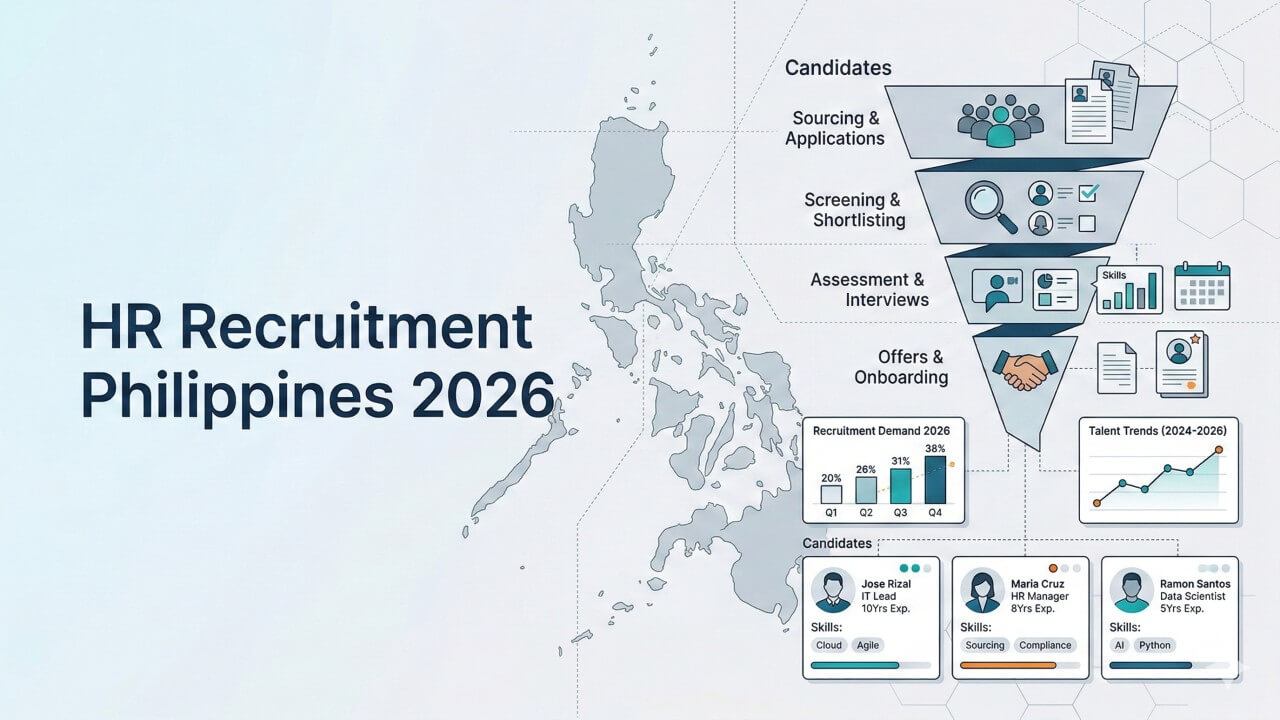
For HR Recruitment Philippines programs, track the following metrics consistently. Many leaders review this HR Recruitment Philippines scorecard monthly:
- Time to first interview
- Time to offer
- Offer acceptance rate
- Source quality (hires per channel)
- First-90-day retention
Outsourcing and talent solutions for HR Recruitment Philippines: what “good” looks like
If your organization is building a talent acquisition Philippines capability for the first time, prioritize process clarity before tooling.
Outsourcing is not a single choice; it is a spectrum. When people search for recruitment outsourcing Philippines, they are usually trying to understand both speed and governance. The most effective partnerships share three traits:
Clarity of scope: who owns sourcing, screening, scheduling, offer management, and onboarding.
Transparency: regular reporting on pipeline health, conversion rates, and blockers.
Compliance discipline: when employment, payroll, or statutory obligations are involved, compliance is designed into the workflow rather than added later.
For organizations entering the market or scaling quickly, Philippine Hub Partners can help structure the right mix of recruitment outsourcing, RPO, and compliance support, so teams can focus on delivery.
Key Takeaways
- HR Recruitment Philippines in 2026 is shaped by faster candidate decision cycles, higher expectations on flexibility, and stronger competition for niche skills.
- Organizations are increasingly using structured interviews, work samples, and analytics to improve predictability and reduce time-to-fill.
- Recruitment outsourcing and RPO are most effective when scope is clear, reporting is regular, and hiring managers stay accountable.
- An Employer of Record can enable compliant hiring without a local entity and can reduce friction for time-sensitive growth plans.
- The best talent solutions combine speed with compliance discipline, not one at the expense of the other.
Conclusion
In 2026, HR Recruitment Philippines is no longer a “post and wait” function. HR Recruitment Philippines now behaves like a performance function with clear leading indicators. It is an operating system: clear role design, fast pipelines, structured evaluation, and the right mix of internal and external capability. Whether you hire directly, use outsourced recruiting, adopt RPO, or employ through an EOR, the winning approach is the one that delivers predictable hiring outcomes and a strong candidate experience.
If you are planning a hiring wave or entering the Philippine market for the first time, align your operating model early, then optimize for speed and consistency. Done well, HR Recruitment Philippines becomes a strategic lever, not an administrative bottleneck.
FAQs
What roles are most in demand in the Philippines in 2026?
In-demand roles often include customer experience leaders, finance and accounting specialists, data and analytics roles, software engineering, and digital operations. Demand varies by industry, but “process plus tools” skills are consistently valued.
What is RPO and when should a company use it?
Recruitment Process Outsourcing (RPO) is when an external provider manages part or all of your recruiting workflow. It is most effective when you have sustained hiring volume, want consistent process quality, or need better sourcing capacity without growing internal headcount.
How does an Employer of Record work in the Philippines?
An EOR becomes the legal employer for your hires in the Philippines, managing compliant contracts, payroll, and statutory requirements. Your organization still manages day-to-day work, performance, and priorities.
How much do recruitment agencies typically charge in the Philippines?
Agency fees vary by role seniority and hiring model. Contingency recruitment is commonly priced as a percentage of annual salary, while retained search and RPO use different fee structures. The best comparison is cost-per-hire and time-to-fill, not only the headline fee.
Is recruitment outsourcing safe for compliance?
It can be, but only if responsibilities are explicit. If a partner is involved in employment, payroll, or worker classification, compliance must be built into the process. Many companies use a combined RPO + EOR approach to reduce legal uncertainty.
What is the fastest way to hire in the Philippines without opening a local entity?
For many organizations, using an EOR is the fastest compliant route because it removes the need to set up a local entity before onboarding.