

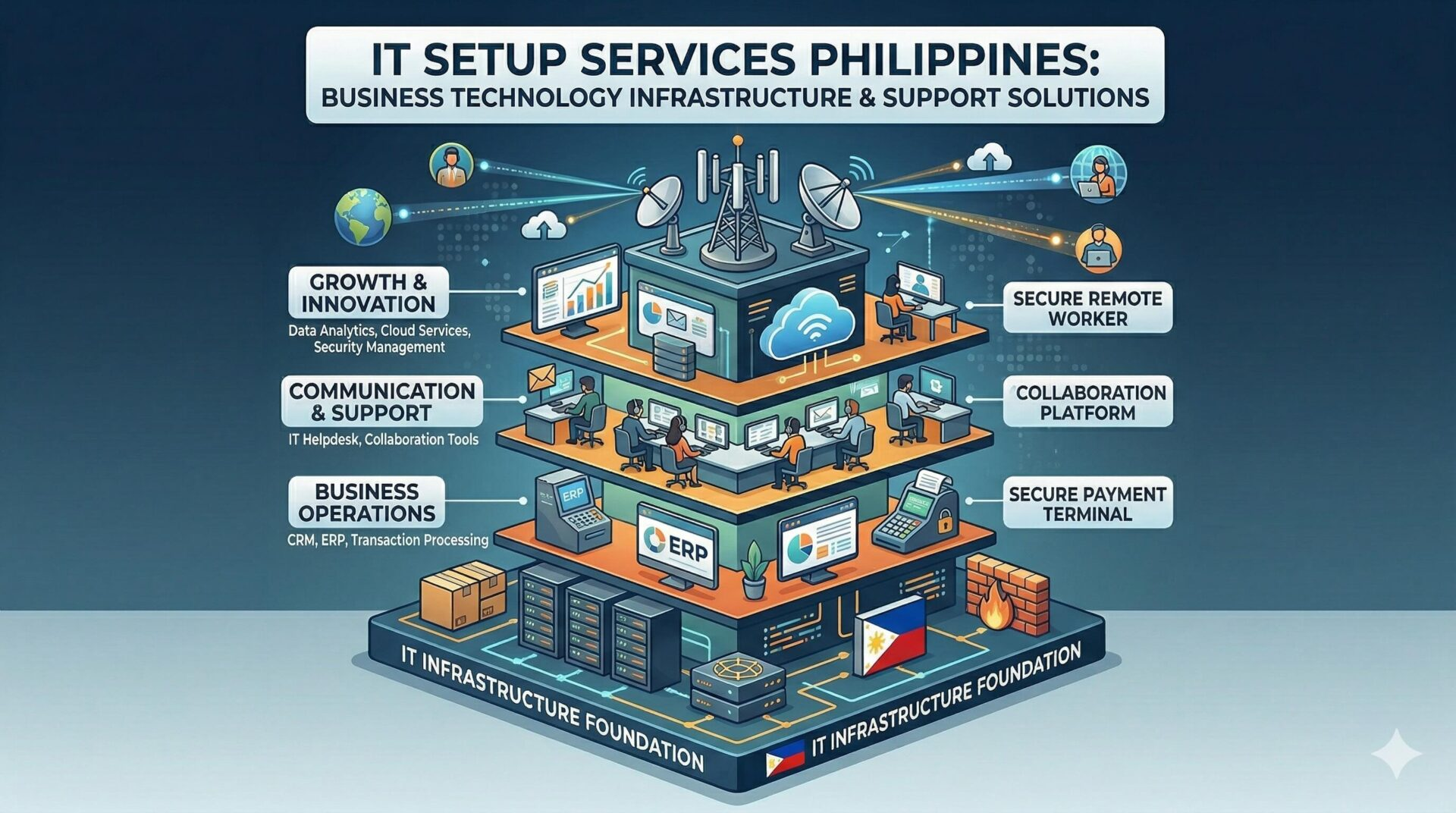
IT setup services Philippines help new and expanding companies design, deploy, secure, and support the technology stack they need to operate legally and efficiently. In practice, that usually means combining network installation, cloud productivity tools, business email, domain setup, cybersecurity controls, data privacy safeguards, and ongoing support into one coordinated rollout.
Companies entering the Philippines often treat registration as the hard part. In reality, technology readiness becomes the operational bottleneck. That is why IT setup services Philippines are best approached as a business enablement function, not a last-mile technical task. For serious entrants, IT setup services Philippines should sit inside the launch plan from the outset.
Why IT setup matters when entering the Philippine market
A business can register online through the Philippine Business Hub, but launch readiness requires more than legal formation. Once the entity is live, teams need secure communications, compliant handling of personal data, resilient internet access, and tools that match how the organization will actually work. The practical role of IT setup services Philippines is to close that gap. In other words, IT setup services Philippines turn a registered company into a working company.
A structured implementation aligns four layers at once: workplace infrastructure, user productivity, security and privacy controls, and support processes. When those layers are planned together, leaders avoid the common pattern of buying hardware first, patching software later, and documenting controls only after an incident or audit request.
Consider a simple example. A company opens a representative office in Taguig with twelve employees, two external contractors, and a parent company overseas. Without a proper setup, users end up sharing credentials, onboarding is manual, device standards vary, and files sit across personal drives. With professional IT setup services Philippines, the company can start with role-based accounts, managed devices, secure Wi-Fi, business email, shared cloud storage, backup routines, and documented access rights from day one.
What IT setup services Philippines usually include
The phrase sounds broad, so it helps to define it clearly. IT setup services Philippines are the coordinated technical and operational services used to build a company’s initial business technology environment in the country. The best IT setup services Philippines connect planning, deployment, security, and support rather than treating them as separate purchases. They typically combine planning, procurement guidance, deployment, security configuration, and post-launch support.
For most organizations, the core scope of IT setup services Philippines includes:
- IT infrastructure planning and consultation
- Office network installation, including routers, switches, firewalls, and Wi-Fi design
- Business email and cloud setup through Google Workspace or Microsoft 365
- Domain registration and DNS configuration
- Cloud productivity deployment for collaboration and shared storage
- Endpoint setup for laptops, desktops, and mobile devices
- User provisioning, identity controls, and access administration
- Baseline cybersecurity controls such as MFA, backups, endpoint protection, and logging
- Help desk or managed support for incidents, changes, and maintenance
This is where the service becomes especially relevant to a corporate audience. Good IT setup services Philippines do not stop at installation. They map systems to operating reality: who needs access, what data is sensitive, what must stay available, what can be standardized, and what should be outsourced.
Business IT infrastructure Philippines: the building blocks that matter
When decision-makers evaluate business IT infrastructure Philippines options, they tend to focus on hardware lists. That is necessary but incomplete. Infrastructure is the full operating foundation that supports connectivity, collaboration, security, and continuity.
Start with connectivity. For a corporate office, this usually means choosing the right primary ISP, assessing service-level expectations, and deciding whether backup connections are justified based on downtime tolerance.
Next comes cloud and identity. Many companies entering the market no longer want heavy on-premise infrastructure. They want cloud-first collaboration, centralized user administration, and easier onboarding for distributed teams. In that model, the infrastructure strategy is less about server rooms and more about identity management, secure collaboration, device policies, and reliable access from anywhere.
Then there is business continuity. If your finance lead cannot access shared files, or your sales team loses email for half a day, operations stall. Sound architecture therefore includes backup, recovery, and failover thinking early, not as a later upgrade.
IT support services Philippines versus one-time setup
Many buyers conflate deployment with support. They are related, but they solve different problems. IT support services Philippines focus on keeping systems operational after launch through monitoring, troubleshooting, maintenance, patching, and user assistance. Setup gets the environment live. Support keeps it reliable.
The distinction matters because many launch projects fail after a technically correct go-live. Accounts are created, devices are delivered, and Wi-Fi works, but nobody owns license reviews, endpoint updates, access revocation, or incident triage.
This is why the strongest providers combine IT setup services Philippines with a transition plan into ongoing support. A good handoff defines ticket channels, response expectations, asset records, user administration workflows, and escalation paths. For leadership teams, that translates into less downtime, clearer accountability, and more predictable operating cost.
Managed IT services Philippines and when they make sense
Managed IT services Philippines go a step further than reactive support. In a managed model, the provider proactively monitors systems, applies patches, maintains security tooling, manages backups, and supports users under an agreed operating framework. That is often the right fit for companies that need dependable IT outcomes but do not want to hire a full local internal team on day one.
This model is especially effective in four situations:
- A foreign company is opening a Philippine entity but wants a lean initial footprint
- A hybrid or remote-first team needs standardized onboarding and endpoint control
- A fast-growing company expects headcount changes and needs scalable support
- A regulated or client-facing business wants stronger documentation, security, and uptime discipline
For many organizations, managed IT services Philippines create a stable operating layer before internal IT maturity catches up. They are also useful for lean corporate teams that need governance without building a full service desk immediately.
Compliance, privacy, and cybersecurity cannot be bolted on later
For companies handling employee, customer, vendor, or applicant information, privacy and security are operational requirements. The Philippines’ Data Privacy Act and its implementing rules apply to organizations processing personal data. What this means in practice is straightforward. If a company is collecting resumes, storing customer records, running payroll, or using collaboration tools that hold personal data, IT setup decisions are already privacy decisions.
Shared inboxes, weak passwords, unmanaged devices, and unclear retention practices are not merely messy. They create compliance and security exposure. That is why mature IT setup services Philippines include security baselines from the start: multi-factor authentication, role-based access, device controls, secure backups, log visibility, and documented handling of accounts and data.
The goal is not overengineering. It is establishing a sensible minimum control set early enough that growth does not multiply unmanaged risk.
How to choose the right provider
Not all providers solve the same problem. Some are hardware resellers. Some are MSPs. Some are corporate-services firms that can bridge business setup and operational launch. For a new market entrant, that last category can be especially useful because the technology rollout is tied to entity launch, hiring, and office readiness.
Evaluate providers against five criteria:
- Business context understanding: Can they design around your actual operating model, not just generic equipment lists?
- Breadth of scope: Do they cover network, email, cloud, domain, security, and support, or only one slice?
- Documentation discipline: Will you receive inventories, access records, configuration notes, and admin handover?
- Security baseline: Do they include MFA, backups, endpoint controls, and least-privilege access by default?
- Scalability: Can the same team support ten users today and fifty users six months from now?
For example, Philippines Business Registration positions its own offer around infrastructure planning, office network installation, business email and cloud setup, and domain registration, which is a credible baseline for IT setup services Philippines.
A practical rollout framework for 2026
The most effective deployments follow a staged sequence rather than a shopping spree. A practical 2026 framework looks like this:
- Define the operating model: office-based, hybrid, remote-first, or multi-site
- Identify critical systems: email, collaboration, finance, HR, CRM, shared storage
- Establish identity and access rules before device deployment
- Set connectivity, Wi-Fi, and backup standards for each location
- Configure business email, domain, and cloud workspace
- Apply security baselines, including MFA, endpoint protection, and backups
- Document ownership, admin access, and support processes
- Move from launch support into recurring operations
This sequence works because it reduces rework. Teams stop buying devices before they know policy, stop creating users before they know roles, and stop adopting tools before they know ownership.
Key Takeaways
- IT setup services Philippines are most valuable when treated as a business launch function, not a standalone technical task.
- Business IT infrastructure Philippines should be designed around operating model, data sensitivity, and growth plans, not just hardware lists.
- IT support services Philippines protect the value of the initial rollout by preventing configuration drift and unmanaged downtime.
- Managed IT services Philippines are often the fastest path to stable operations for lean, fast-growing, or foreign-led teams.
- Security, privacy, and documentation should be built into the setup from day one so growth does not multiply risk.

Conclusion
The strongest market-entry teams treat technology the same way they treat legal formation, finance, and hiring: as foundational. IT setup services Philippines create the operating layer that allows a newly registered business to communicate, collaborate, protect data, and scale without improvising every technical decision under pressure. In 2026, IT setup services Philippines are no longer optional for companies that want a disciplined launch.
For a corporate audience, the implication is simple. The right provider should not only install tools. They should help you launch an environment that is secure, documented, supportable, and ready for growth. That is what turns technology from a startup headache into operational leverage.
FAQs
What are IT setup services Philippines?
IT setup services Philippines are the professional services used to design, deploy, secure, and support a company’s initial technology environment in the country. They usually include network setup, business email, cloud tools, domain configuration, device onboarding, and baseline cybersecurity.
How are IT support services Philippines different from setup services?
IT support services Philippines focus on keeping the environment running after launch through troubleshooting, maintenance, patching, and user support. Setup services build the environment; support services sustain and improve it.
Do startups and small teams need managed IT services Philippines?
Yes, often more than they realize. Managed IT services Philippines help smaller teams avoid inconsistent setup, unmanaged devices, and weak access control while giving founders predictable operating support without building a full internal IT function immediately.
What is included in business IT infrastructure Philippines planning?
Business IT infrastructure Philippines planning typically covers connectivity, Wi-Fi, user accounts, cloud collaboration tools, device standards, security controls, backup, and support processes. The exact scope depends on whether the business is office-based, hybrid, or remote-first.
Why should IT setup be coordinated with business registration and launch?
Because legal formation does not create operational readiness. Coordinating IT setup services Philippines with office launch, hiring, and compliance reduces downtime, accelerates onboarding, and lowers security and privacy risk. Well-planned IT setup services Philippines also reduce rework after the first hires are onboarded.